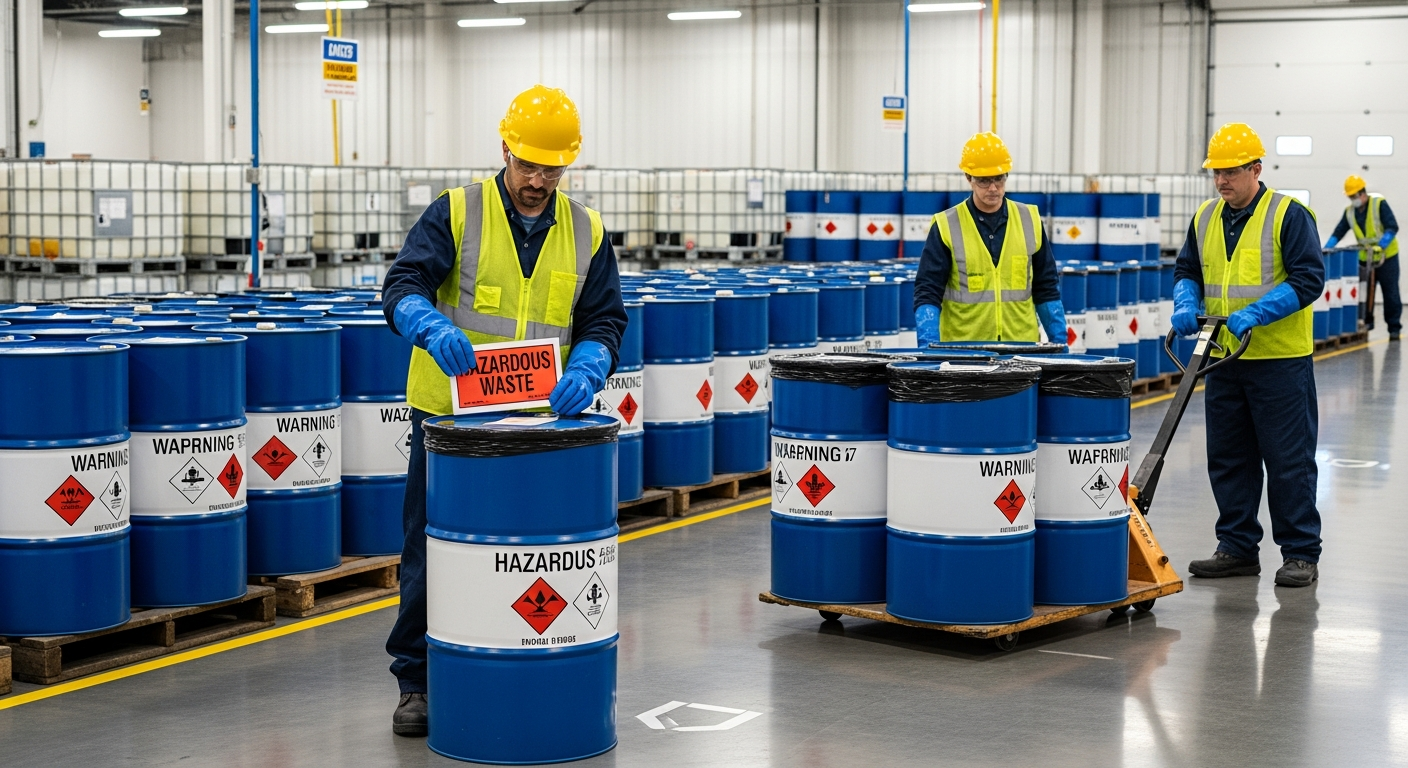
Industrial Hazardous Waste
Licensed RCRA Disposal & Manifesting
RCRA waste classification, manifesting documentation, and compliance guidance for South Florida manufacturers, contractors, and facilities — covering manufacturing byproducts, contaminated soil, spent solvents, and process chemicals.
Industrial Hazardous Waste We Manage
Industrial operations generate multiple RCRA-regulated waste streams. Exodus handles all of them under one compliant program — no mixing, no guesswork.
Manufacturing Process Byproducts
Industrial manufacturing generates K-listed source-specific hazardous waste — byproducts from specific processes classified as hazardous regardless of their chemical properties.
- Paint sludge & coating waste
- Metal finishing & plating waste
- Wastewater treatment sludge
- Still bottoms from solvent recovery
Contaminated Soil & Materials
Soil, rags, absorbents, and equipment contaminated with RCRA hazardous substances must be managed as hazardous waste — not disposed of in regular dumpsters or landfills.
- Petroleum-contaminated soil
- Solvent-soaked rags & absorbents
- Contaminated personal protective equipment
- Spill cleanup debris & materials
Spent Industrial Chemicals
Spent degreasing solvents, electroplating bath solutions, and process chemicals that are no longer usable become RCRA-regulated hazardous waste requiring licensed disposal.
- Spent degreasing & cleaning solvents
- Used electroplating bath solutions
- Expired industrial process chemicals
- Off-spec or rejected chemical inventory
Why Industrial Generators Choose Exodus
RCRA Generator Compliance
We help you determine your generator status and stay within accumulation time limits — avoiding permit requirements and enforcement actions.
RCRA Compliance Support
Exodus helps industrial generators understand generator status, accumulation requirements, manifesting obligations, and applicable RCRA compliance standards.
Cradle-to-Grave Manifesting
Full Uniform Hazardous Waste Manifesting tracks every shipment from your facility to a licensed TSDF — your legal protection.
Emergency Response Ready
Spill response and emergency industrial waste cleanout services available for unplanned events across South Florida.
How Industrial Hazardous Waste Disposal Works
Waste Stream Assessment
We review your manufacturing processes to identify RCRA-regulated waste streams and determine your generator status (VSQG, SQG, or LQG).
Container & Label Setup
UN-approved drums and containers with RCRA-compliant hazardous waste labels are delivered and positioned at accumulation points.
Waste Classification & Documentation
RCRA waste identification, incompatibles segregation guidance, and Uniform Hazardous Waste Manifesting documentation — helping your facility meet generator obligations.
Full Compliance Documentation
You receive the signed manifest, LDR notifications, and Certificate of Disposal — everything needed for RCRA generator records.
Industries & Facilities We Serve
Manufacturing Plants
Production facilities generating K-listed process byproducts, spent solvents, and contaminated materials need licensed RCRA hazardous waste management programs.
Auto Repair & Body Shops
Automotive shops generate used oil filters, paint waste, degreasing solvents, and antifreeze — all requiring compliant hazardous waste disposal.
Construction & Demolition
Demo projects can generate lead paint chips, asbestos-containing materials, and petroleum-contaminated soil classified as hazardous waste.
Metal Fabrication & Finishing
Metal finishing operations generate electroplating sludge, cyanide bath waste, and chromium-containing materials — all strictly RCRA-regulated.
Printing & Coatings
Print shops and coating operations generate ink solvents, cleanup solvents, and coating waste streams classified as F-listed RCRA hazardous waste.
Fleet Maintenance Facilities
Fleet maintenance operations generating used oil, brake cleaner residues, and contaminated fuel must manage these materials as hazardous waste.
Related Hazardous Waste Services
FAQ — Industrial Hazardous Waste Disposal
Listed waste appears on EPA's F, K, P, or U lists in 40 CFR 261 and is automatically hazardous. Characteristic waste exhibits ignitability (flash point <140°F), corrosivity (pH ≤2 or ≥12.5), reactivity, or toxicity. Industrial generators typically produce both types.
Your RCRA generator status (VSQG, SQG, or LQG) is determined by how much hazardous waste you generate per month. Status determines accumulation time limits (90 to 270 days), training requirements, contingency planning obligations, and reporting requirements. Misclassifying your status is one of the most common RCRA violations.
Used oil is managed under a separate RCRA framework (40 CFR Part 279) if it is recycled. Used oil mixed with hazardous waste must be managed as hazardous waste. Exodus provides both used oil collection and hazardous waste disposal services.
A TSDF (Treatment, Storage, and Disposal Facility) is an EPA-permitted facility authorized to treat, store, or dispose of RCRA hazardous waste. Industrial hazardous waste must be directed to a permitted TSDF — documented on every uniform hazardous waste manifest. Exodus helps facilities understand RCRA TSDF requirements and what generator documentation obligations apply before engaging a licensed disposal facility.
Cost depends on waste type, volume, containers, and frequency. Solvents, corrosives, and flammables are priced per drum or per pound. Contact Exodus for a free waste stream assessment and quote based on your specific industrial processes.
Request an Industrial Waste Assessment
Tell us about your industrial processes and we'll identify your RCRA waste streams, generator status, and the most cost-effective compliant disposal program for your operation.
← Back to Hazardous Waste Overview